Showing posts with label provincial rates. Show all posts

Monday, August 10, 2026

DOLE AO 264 is mema not a memo


The Department of Labor and Employment’s (DOLE) issuance of Administrative Order 264 Series of 2026 resolves nothing and clarifies nothing about the TRO on the P85 wage hike. Thus, it does not diminish the need for trade unions and DOLE to secure the immediate lifting of the Pasig TRO. 


Likewise, AO 264 does not address the structural defect of regionalized wage setting. Reform of provincial rates requires congressional action and a new law.  


This is the bigger problem to confront. For this, labor solidarity and direct actions are needed to stop capitalists’ resistance to change and endless maneuvers, like the TRO.

Friday, May 22, 2026

PM Suportado ang Panawagang ₱200 Dagdag-Sahod sa NCR


Suportado ng Partido Manggagawa (PM) ang petisyon ng Kapatiran ng mga Unyon at Samahang Manggagawa o Kapatiran para sa ₱200 dagdag sa arawang sahod ng mga manggagawa sa National Capital Region (NCR), kasabay ng panawagan sa Regional Tripartite Wages and Productivity Board na agarang aksyunan ito sa harap ng tumitinding krisis sa kabuhayan. 


Sa harap ito ng isinagawang public consultation ng NCR Regional Wage Board kaugnay ng mga petisyon sa dagdag sahod.


Ayon sa PM, ang hinihinging dagdag-sahod ay hindi luho kundi kinakailangang hakbang upang maibalik ang nawalang halaga ng sahod dahil sa mabilis na pagtaas ng presyo ng langis, pagkain, kuryente, at pamasahe bunsod ng kaguluhan sa Gitnang Silangan.


“Ang ₱200 wage hike ay hindi sobra. Ito ay pagbawi lamang sa nawalang halaga ng sahod ng manggagawa matapos ang sunud-sunod na taas-presyo. Nagkaputukan sa Middle East, nagtaasan ang presyo sa Pilipinas, pero ang minimum wage earners ay pinabayaang magtiis,” pahayag ni Renato Magtubo, chairperson ng Partido Manggagawa. 


“Under attack ang kabuhayan ng manggagawa kaya dapat mabilis ang tugon ng wage board. Kapag mabilis tumaas ang presyo, dapat mabilis din ang dagdag-sahod.”


Ipinaliwanag ng PM na ang kasalukuyang minimum wage na ₱695 sa NCR ay hindi na sapat upang tugunan ang araw-araw na gastusin ng isang pamilyang manggagawa. Batay sa consumer price index (CPI) ng NCR na nasa 131.2 noong Abril, bumagsak na sa humigit-kumulang ₱530 ang tunay na halaga ng minimum wage, katumbas ng mahigit ₱165 wage loss kada araw. Dagdag pa rito, tinatayang mahigit ₱1,200 kada araw ang kinakailangan ng isang pamilyang may limang miyembro upang mabuhay nang disente sa NCR.


Binigyang-diin din ng Partido Manggagawa na ang pagtaas ng sahod ay hindi lamang usapin ng social justice kundi isang makatuwirang patakarang pang-ekonomiya. Anila, ang mas mataas na kita ng manggagawa ay direktang napupunta sa konsumo tulad ng pagkain, transportasyon, edukasyon, at iba pang pangunahing pangangailangan, na nagpapalakas sa lokal na negosyo at ekonomiya. “Ang manggagawa ay hindi lamang producer kundi konsyumer din. Kapag may kakayahan silang gumastos, umiikot ang ekonomiya, lumalago ang negosyo, at dumarami ang trabaho,” ani Magtubo.


Sa huli, nanawagan ang Partido Manggagawa sa wage board na dinggin ang hinaing ng milyun-milyong manggagawa at ipagkaloob ang ₱200 dagdag-sahod bilang makatarungan at agarang tugon sa krisis sa kabuhayan. “Hindi limos ang hinihingi ng manggagawa. Ang hinihingi niya ay living wage na nakasaad mismo sa Konstitusyon—isang sahod na magbibigay dignidad sa kanyang buhay at sa kanyang pamilya,” pagtatapos ni Magtubo.

Photos at https://www.facebook.com/partidomanggagawa/posts/pfbid0M9Z9hJdzjb9koxNBL4jbFoGxFVHKHQBADZS5Qno4MfnxV6JgLK8g9d1J9q9EgB6pl


PRESS RELEASE

Partido Manggagawa 

22 May 2026

Monday, May 11, 2026

Reforms along with impeachment—Partido Manggagawa

The House of Representatives, by an overwhelming vote of 255, has impeached Vice President Sara Duterte. For the second time, the Senate is obligated to convene as an impeachment court and place the impeached official on trial. Walang lusot dito—sino mang liderato man ang maupo sa Senado.


But if the recent Senate coup was engineered precisely to delay or derail this process, including shielding political allies from accountability such as the ICC issue, then it only exposes a deeper institutional crisis. Lalabas na hindi lamang si Sara Duterte ang dapat sumailalim sa paglilitis—kailangan din ng Senado na maglinis ng sarili. An institution that evades accountability loses the moral authority to judge others.


The same challenge applies to the House of Representatives. Hindi dapat matapos sa impeachment ang usapin ng pananagutan. Kung seryoso ang Kamara sa “self-cleansing,” kailangan nitong ipasa ang Anti-Political Dynasty Bill, ang mga nakabinbing P200 wage hike bill, at ang abolition of provincial wage rates na matagal nang nagpapahirap sa manggagawa. At marami pang ibang mahalagang social legislation.


Sayang ang impeachment kung hindi matutuloy at kung walang kasabay na reporma.


Accountability without structural change risks becoming mere spectacle.


Ang tunay na paglilinis ng gobyerno ay hindi lang pagpapanagot sa indibidwal na opisyal kundi pagwawasto din sa mga problemang istruktural katulad ng dinastiya, katiwalian, at anti-poor policies.

MEDIA STATEMENT

Partido Manggagawa

Friday, April 24, 2026

Labor group asks BBM to ok wage petitions


The group Kapatiran ng mga Unyon at Samahang Manggagawa today called on President Bong Bong Marcos, Jr. to exercise moral suasion on the regional wage boards to immediately act on pending salary adjustment petitions. Yesterday, Kapatiran filed a petition for a P200 wage hike at the NCR wage board. Last March 27, a coalition of labor groups led by Partido Manggagawa and Sentro ng mga Progresibo at Nagkakaisang Manggagawa filed a similar petition for a P100 salary increase in Central Visayas. Next week, another alliance plans to submit a petition for a wage adjustment for Western Visayas workers.


“President Marcos, Jr., the P30 reduction in the price of LPG is not enough. Workers need a P200 wage hike. With great power comes great responsibility. Use your emergency powers to help workers. What kind of state of emergency is this if there are no ambulances for wage earners?” stated Rey Almendras, president of the group Kapatiran and also of the Philip Morris Fortune Tobacco Labor Union.


The wave of wage petitions foreshadows the suite of demands in the coming Labor Day protests next week. Aside from a wage hike, Labor Day demands include higher assistance for informal workers, improved public employment program, suspension of the excise tax on oil, abolition of the vat on oil and electricity, review of the oil deregulation law and electricity privatization, state-led renewable energy program and a stop to the US-Israel war on Iran. There are Labor Day marches planned in Metro Manila, Metro Cebu, Bacolod and Iloilo by the group Partido Manggagawa in alliance with other labor organizations. Kapatiran is joining the planned Labor Day protest in Metro Manila.


Almendras insisted that “Lahat na nagtaas pero ang sweldo napako. Tama na. Sobra na. Umento na! High inflation due to the war on Iran constitutes a supervening event that necessitates the P200 wage hike. The government’s own data—from the Philippine Statistics Authority—reveals that the current P695 minimum wage in Metro Manila has an effective real value of only P539.18, representing a loss of P155.82 since 2018. We are not really asking for a wage hike but simply wage recovery.”


“The seriousness of the current economic conditions has been formally acknowledged by the National Security Council, which has declared that the Philippines is facing a socio-economic crisis. Sapat na itong batayan para sa deklarasyon ng supervening event,” Almendras argued. It is still two months before the lapse of one year after the last NCR wage order.


Photos of filing at PM FB: https://www.facebook.com/partidomanggagawa/ 


April 24, 2026

Kapatiran ng mga Unyon at Samahang Manggagawa

Wednesday, March 4, 2026

Workers to Congress: Don’t exploit Middle East crisis to kill wage reform bill


Photo from ABS-CBN.com

The Partido Manggagawa (PM) on Wednesday called on the leadership and members of the House of Representatives to stay focused and continue deliberation of the bill abolishing the provincial rate in the face of the escalating military conflict in the Middle East.


PM Chair and former partylist representative Renato Magtubo made this call amid fear that the ongoing war could trigger restraint among policymakers, for instance, preventing the enactment of the Kamanggagawa wage reform bill which is awaiting plenary approval at the House of Representatives prior to the outbreak of the Middle East crisis.


Local pump prices of oil have started to spike despite the assurance made by the Department of Energy (DoE) that the country has enough inventory. The Philippine peso weakened further since Monday. Prices of agricultural inputs are expected to rise also as more than 80% of fertilizer supply is imported.


“Our economic managers, in tandem with capital, are very clever at throwing a monkey-wrench to any wage proposal even under normal conditions. Now they will surely exploit the Middle East crisis to kill the wage reform bill. The House must shield itself from this kind of pressure,” stated Magtubo.


Abolishing the provincial rate by establishing a national minimum wage and designating the NCR rate as floor wage is an initial step aimed at rectifying 36 years of injustice under the Regional Tripartite Wages and Productivity Board (RTWPB), explained Magtubo.


“Living wage remains the ultimate ‘regime change’ workers will continue to demand,” added Magtubo.


“Nadamay at pinahirapan na nga tayo ng ‘regime change’ project ni Donald Trump at Netanyahu sa Iran. Huwag nang dagdagan pa ang pasaning ito sa pamamagitan ng pagpatay sa panukalang wage reform law,” concluded Magtubo.

PRESS RELEASE

Partido Manggagawa

04 March 2026

Tuesday, July 1, 2025

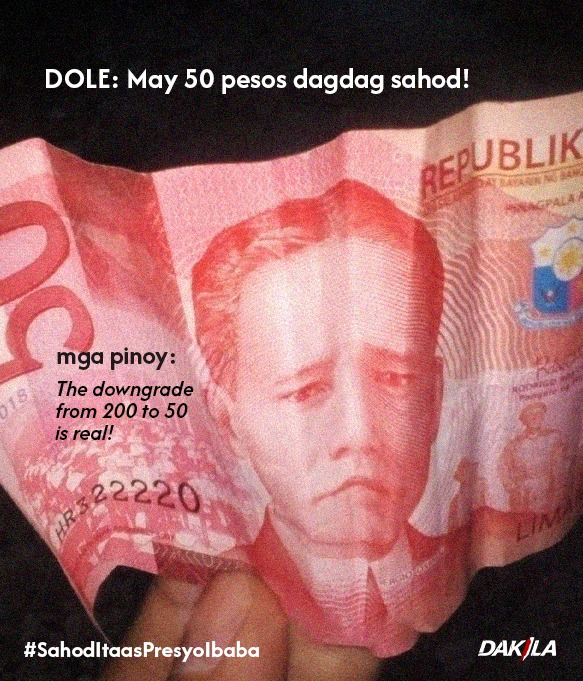
Despite P50 NCR wage order: Labor vows to push P200 legislated wage bill in new Congress


Image from Dakila

The labor group Partido Manggagawa (PM) stated that labor groups are united in pushing a legislated wage increase as a pathway to improving the living conditions of workers and a step towards reforming the wage fixing system.


 “It is the high-profile campaign of the labor movement for a P200 legislated increase that nudged the NCR wage board to enact the highest ever amount of minimum hike in the region lest it be criticized by workers for being stingy and useless,” Lawrence Cusipag, one of PM’s spokespersons, asserted.


“With the 20th Congress convening by July 28 and despite the P50 wage order in Metro Manila yesterday, we reiterate out demand for a P200 salary adjustment that is nationwide and across-the-board so that all workers benefit. Even informal workers and micro entrepreneurs will also gain from this measure through the multiplier effects of a robust purchasing power of formal workers,” explained Cusipag.


Labor groups will join multisectoral organizations in the planned mobilization on the State of the Nation speech of President Bong Bong Marcos, Jr. which is also the official opening of the new Congress.


“Labor will raise the demand for a legislated wage hike in opposition to the provincial rates which is an instrument to cheapen wages of workers. Labor productivity has risen continuously for the past two decades even as real wages have stagnated. Employers have monopolized the fruits of so-called economic progress,” Cusipag ended. ###


Thursday, May 22, 2025

KAPATIRAN calls for ₱200 wage hike, urges NCR Wage Board to defer to Congress

PNA photo by Yancy Lim


Metro Manila — In a strongly worded statement delivered at the NCR wage consultation today, the labor group Kapatiran ng mga Unyon at Samahang Manggagawa (KAPATIRAN) called on the regional wage board to defer action on wage orders this year and instead support a legislated wage hike through Congress. The Regional Tripartite Wages and Productivity Board–National Capital Region held a “Labor Sector Wage Consultation” this afternoon at the Philippine Trade Training Center in Pasay City.


Rey Almendras, KAPATIRAN President, emphasized the worsening economic hardships faced by Filipino workers despite official claims of low inflation and declining unemployment. Citing recent survey data, Almendras highlighted that over a quarter of Filipino families are experiencing hunger, while more than half consider themselves poor—the highest levels seen in decades.


“The minimum wage—even with almost yearly increases—remains below the poverty threshold. Workers are starving while government figures paint a rosy picture,” Almendras said. KAPATIRAN pointed to the erosion of real wages, noting that the current ₱645 nominal daily wage in Metro Manila has a real value of only ₱519—₱126 short of its 2018 equivalent. The group argues that, when combining wage recovery with a just share in productivity gains, workers are entitled to no less than a ₱200 daily wage increase.


This, Almendras noted, is not just a demand but a constitutional right. “The Constitution mandates a living wage and a just share in the fruits of production. But workers haven’t felt either,” he said. “Despite rising productivity, the real wage hasn’t kept up.”


KAPATIRAN also expressed frustration over past wage orders issued by the NCR Wage Board, which fell far short of workers' demands—granting only ₱40 and ₱35 increases in 2023 and 2024 respectively. Kapatiran filed a P100 wage petition in December 2022.  “We’ve lost hope in the regional wage board. They’ve been blind and deaf to workers’ pleas. It’s time for a new path,” Almendras declared.


The group is now joining a broader coalition of labor organizations pushing for a national, legislated wage hike in Congress, citing the stronger prospects brought by the recent election of pro-worker legislators. In closing, Almendras issued a direct appeal to the NCR Wage Board: “Please refrain from issuing a wage order this year. Let Congress do its job. With workers’ actions inside and outside Congress, we hope to finally win our demand.” 

PRESS RELEASE

Contact Rey Almendras

President, Kapatiran

Saturday, January 4, 2025

2024 in Review: Workers caught between economic difficulties and political intramurals


In 2024, workers faced severe challenges in their wages, benefits and working conditions as they were caught in the vise of economic difficulties brought about by the cost-of-living crisis and escalating intramurals between the two leading political dynasties in the country.


While the average inflation of 3.2% in 2024 was almost half compared to 2023, it continued to erode the purchasing power of wages. Relatively higher price increases in food and utilities also disproportionately hit the bottom rungs of the income deciles, meaning the formal and informal workers. Thus, the demand for another round of minimum wage increases in 2024 was a recurring theme for organized labor. The campaign for a wage hike was two-pronged with wage bills for a P150 increase filed at Congress and at the wage boards.


The Senate approved a P100 increase in the minimum wage in February 2024. This advance was a result of organized labor successfully leveraging the rift between the upper and lower house of Congress over the latest move to amend the Constitution. The Senate stood pat against charter change and instead pushed for the wage bill’s passage. However, the reverse was the case in the House of Representatives. Despite conducting hearings on the P150 wage hike bill, the House Labor Committee sat on the proposal and basically killed it. In contrast with this inaction on the workers’ demand for a wage hike, the House was fast and furious with the quadcomm hearings on the drug war and extra-judicial killings during former President Rodrigo Duterte’s administration and the investigation on the controversial budget of the Office of Vice President Sara Duterte and the Department of Education during her tenure.


The year ended with no legislated wage hike but with wage orders for several regions. Notwithstanding the wage orders, minimum wages in all the regions—including those which increased, like Metro Manila, Calabarzon, Cebu and Central Luzon—remained below the official poverty line. Even though the threshold was assailed for being too low—as the controversy over the P64 daily food budget revealed. With the wage boards perpetuating a system of poverty wages, calls for the abolition of provincial rates became popular.


On another front, organized labor and civil society allies fought a defensive war to keep Philhealth funds devoted to improving benefits services to members and providing services for indigents as mandated by the Universal Health Care Act. P60 billion of Philhealth’s funds were transferred by President Bong Bong Marcos Jr. to fund unprogrammed items in the national budget before the Supreme Court stopped in October the last tranche of P29.9 billion.


Another battle erupted in December when the Congressional bicameral conference committee removed the subsidy for Philhealth along with cuts in other social services. The labor coalition Nagkaisa led protests in Metro Manila and Cebu—including a big rally in Mendiola—to call for the restoration of the Philhealth subsidy and social services budget. But President Marcos Jr. did not heed the popular clamor as he signed the national budget by year end with the much-assailed budget insertions for ayuda kept intact. Among these was the P26 billion unprogrammed budget for AKAP which has been criticized as funding for electoral patronage. As if on cue, the COMELEC allowed the distribution of ayuda even during the midterm elections this year—breaking with long-established rule of prohibiting the use of public money for vote buying. This means that formal and informal workers will now have to beg trapos for assistance for medical and other emergencies instead of getting health insurance as a right.


Even as demands for higher pay, lower prices, more jobs and decent work remain very popular issues during the election period, prospects are bleak that the polls will result in positive outcomes for workers given that political dynasties—which are evolving from fat to obese—dominate the landscape. Workers have no allies either in the two main political dynasties—the House of Polvoron and the House of Fentanyl—which will be fighting for supremacy in May 2025.


Workers will have to endure worse economic difficulties as political infighting heightens in 2025 and the remaining years of the Marcos, Jr. administration. Nonetheless, this situation also motivates organized labor to engage with public outrage over wanton government corruption and dynastic political dominance. A big multi-sectoral rally this month promises to jumpstart a robust movement for good governance, in which workers’ demands should be embedded and integral. 

Press Statement

January 4, 2025